
Languages Data
Name/Link of Resource
M. Phil./ Ph.D.
- The Kora of pargannah Barabhum the processes of social integration of a tribal community within the Hindu social system
- Demographic Investigation Among the Koras of Midnapur District, West Bengal
- Ethnohistory of the Koras of West Bengal
Research Paper
- The Kora
Project
- Kora : an ecological inventory of the Kora National Reserve, Kenya : Kora Research Project 1982-85 : a joint venture between the National Museums of Kenya and the Royal Geographical Society
Book
- Land and People of Indian States and Union Territories: West Bengal
- The silenced voice : hidden music of the Kora
- Monographic study of Kora tribal community
- Islands in the bush : a natural history of the Kora National Reserve, Kenya
- The Koras and Some little known communities of West Bengal
- People’s Linguistic Survey of India: The Languages of West Bengal
- Bharatiya Bhasha Lok Sarvekshan : Odishara Bhasha Samooh
- Linguistic Survey of India
- Koda
- A Bibliographic Index of the Lesser Known Languages and Dialects of India and Nepal
- Language Shifts Among the Scheduled Tribes in India: A Geographical Study
- Bibliography of Marginal Indian Languages
- Cultural Dimensions on Tribal Health: A Study among the Santa/ and the Kora of Jhargram Sub-division District-Midnapore (West), West Bengal, India
- Kora in hell: Improvisations
- Expressive Morphology in the Languages of South Asia
Book Chapter
- Effect of Bangla on Koda Verbs
- Language and Culture: A Linguistic Anthropological Study of Koda
- The Andaman Islanders of the Bay of Bengal
Dictionary
- English-Hindi-Bangla-Koda Dictionary
- Koda-Bangla-Hindi-English Dictionary
- কোড়া শব্দমালা
Occasional Paper/Brochure
- Atlas of the Worlds Languages Danger
Journal/Seminar Proceedings/Souvenir
Web Resource
West Bengal (WB) | |
|
Birbhum
|
|
West Bengal (WB) | |
|
Birbhum
|
|
| West Bengal (WB) | |||||
| Birbhum | 1 | 1 | 0 | 0 | 0 |
| Graduate | Master | Ph.D. | Technical diploma | Other |
- India
- Birbhum
| West Bengal (WB) | |||||||||||||||||||||||||||||
| Birbhum | 0 | 0 | 0 | 0 | 0 | 0 | 0 | 0 | 0 | 0 | 0 | 0 | |||||||||||||||||
| Private | Public | Private | Public | Private | Public | Private | Public | Private | Public | Private | Public | ||||||||||||||||||
| Primary School | High School/ Inter College | Medical College | Engineering College | Industry | Others | ||||||||||||||||||||||||
| West Bengal (WB) | |||||||||||||||||||||||||||||
| Private | Public | Private | Public | Private | Public | Private | Public | Private | Public | Private | Public | Private | Public | Private | Public | Private | Public | Private | Public | Private | Public | Private | Public | ||||||
| Primary School | High School/ Inter College | Medical College | Engineering College | Industry | Others | Primary School | High School/ Inter College | Medical College | Engineering College | Industry | Others | ||||||||||||||||||
-
By Community
Some groups are working for the Language in W.B.
Koda/Kora is a language of the Austro-Asiatic language family and a non-scheduled language being majorly spoken in West Bengal, Jharkhand and Orissa. According to the CENSUS report (2001 and 2011) and UNESCO’s list of endangered languages, the Koda/Kora linguistic community has been identified as an endangered linguistic community. The word kora means ‘digging the earth’. Koda community originally belongs from Mundari community. They consider their community as the descendants of Santhali ‘father’ and Munda ‘mother’. The tribe Koda/Kora in West Bengal speaks a variety of Mundari language.
Risley argued about the ethnic affiliation of Koras as ‘Kora, Kaora, Khaira, khayra- a Dravidian caste of earth-workers and cultivators in Chotonagpur, Western and Central Bengal probably an offshoot from the Munda tribe.... The Koras of Santhal Pargana, on the other hand claim to have come from Nagpur.’ ( Risley, 1891; 506-507) The tribe Koda/ Kora in West Bengal speaks a variety of Mundari language.
|
Noadangal Village in Birbhum District of West Bengal |
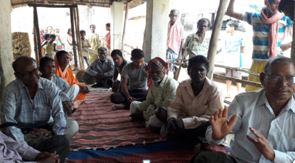
Survey Area:- The present study is based on the survey in Noadangal village, kondopukur village, Khezurdanga village in Birbhum and Raipara and Simlur village in Bardhaman. Noadangal is a village in Birbhum districts where around 70 Koda families stay. Villagers are mostly engage with farming and agriculture. Raipara village in Bardhaman district has a larger population of Koda/ Kora community and the village is named after the community as Kodapara/ Korapara. Around 50-55 Koda/Kora families stay in this village. Here the ratio of school dropout is large. The young generation also is not pursuing higher study. Another village in Bardhaman where the surveyors have gone is Simrul. Around 50 Koda/ Kora families stay here.
The community is staying here for three generations or more. Most of them have told that they are migrated from Jharkhand (than Bihar). Their ancestors came here for farming or to work as a labour to earn their livelihood. As they are staying for several decades in West-Bengal they have started following the culture and rituals of the Bengalis of neighbourhood areas.
Literacy:- Education rate is not very high among Kora people due to the following reasons:
- Not having access of mother-tongue education. Though there are a large number of Kora populations in different villages of Birbhum and Barddhaman, no school offers the primary education in their mother-tongue.
- Economically deprived situation made them to try to earn to feed themselves and their family
In recent days, the young generation is pursuing higher study and for that they are shifting towards adopting Bangla as their first language.
Occupation:- Most of the Kora people are engaged with farming or agriculture. Some people are engaged as daily-wage labour. In recent days, young generation are working as school-teacher or other government sector as well.
Concluding Remarks:- Kora people do not consider their language as a social ‘stigma’, but feel the ‘pressure’ or ‘need’ to shift towards Bangla for pursuing higher studies or job. Younger generation prefer speaking in Bangla with family members or friends. The older generation is also gradually losing the corresponding Kora words for items for not using over the years. Kora is an endangered language with a prominent language shift. Native-speaker of Kora is losing their mother-tongue at family and village domain also. The Kora tribes in Birbhum and Barddhaman district are shifting towards the dominant language Bangla as the Bangla is not only the dominant language of the area, but also Bangla has more ‘economic value’ in respect to education, job and other facilities.
Though Koda has a comparatively larger population, but the speakers, specifically the younger generations are either-i.) not able to speak their mother-tongue and use Bangla at home domain even with their parental and grand-parental generation, or ii) the parental and Young generation speak at home domain in Bangla and Koda both and iii) even the grand-parental generation do not speak their language always at home and thus lost most of the vocabulary items, the language is considered as endangered and needs to be preserved.
The marriage system in Kora tribe is popularly known as dutum. They get married within the Kora community only. Marriage with other community people is not allowed in their societal-system. Earlier, marriage within the same clan or same village was not allowed. However, in recent days, marriage within same village is allowed. After five days of the birth of a new born baby, they observe panchute where women of the village bathe the new born baby and celebrate this occasion with food and cauli boDe or pochui (a local form of alcohol). narta is performed in the child’s first rice ceremony. After the death of any person, they observe kaaman praying the peace of the departed soul. The main priest is called bamre and he does the priesthood for all the ceremonies.
Bonga Puja or Bonga Baru puja is performed by Kora tribes in the end of the month Chaitra. Traditionally they worship the hill of the nearby areas in this puja. However, as the Koras are distributed in different villages of West Bengal where there is no hill in the nearby areas, they worship any big tree (such as Mango or Banyan trees) outside their village. They offer hen to the tree and later have it as Prasad. However, women are not allowed to go in the venue of the puja, instead they do the puja inside a cowshed near their houses.
Some of the other indigenous harvest festivals which they follow are SasogiDi and HindiyagiDi.
The language of the Kora tribe is known as Kora language. Kora language belongs from Austro-Asiatic group. The language shows SOV word order. Vocabulary of the language shows a large number of Mundari or Austric words. However, as these people are migrated in West Bengal for more than last three generation, now days their vocabulary shows a large amount of Bangla loan words as Bangla is the dominant language of this area. Santhali, is the other dominant language in this area. But, most Kora speakers of Birbhum and Barddhaman do not have proficiency in Santhali language.
However, among 5495 Koda/ Kora community people of Birbhum or 10,431 people of Barddhaman, most young adults and children cannot speak Kora/ Koda language or they speak a Bangla mixed variety of Koda/ Kora language, where most of the vocabulary items and sentence constructions show influence of Bangla. In present days, the Kora/ Koda community of West-Bengal has started Bangla as the second language as Kora/ Koda language is not being taught in any school level education, Bangla as the major language of the area is the emerging language among them. Gradually they are shifting towards losing their Koda/ Kora ‘tongue’ and adapting Bangla as the only language. The young generation prefers to use Bangla over Koda/ Kora as their main communication language even within the community people. The young generation prefers to use Bangla over Koda/Kora as their main communication language even within the community people.
Koda has six vowel phonemes, |ɑ| |i| |e| |o| |u| |ᴐ|. Koda grammar shows usage of four nasalized sounds including nasalized vowel, such as |ẽ|, |n|, |ŋ| and |ɲ| sounds. Koda exhibits retroflex |ɽ|, |ɖ| and glottal stop |Ɂ| and glottal fricative |H| sounds. All most all the vowel sounds can be perceived as long, short and in nasalized form.
There are six basic colour-terms in Koda language: hẽnde-black, punɖi-white, sɑsɑŋ-yellow, hareriye-green, giru-brown and ɑɽɑɁ-red.
In Koda language, there are 48 kinship terms. Masculine noun ends with |-ɑ| and feminine noun ends with |-i|, or |-ĩ| sounds, such as –baba for father and maĩ for mother. The maternal kinship terms mostly starts with |-m| sound, such as mama for maternal uncle, mami for maternal aunt. For the people engaged with different occupation, they use the name of the occupation and add the word hᴐɽᴐ, whereas hᴐɽᴐ means ‘man’. Consider the following examples: hᴐɽᴐ-man and farmer- casi hᴐɽᴐ (farmer man). However, this is to be mentioned that the vocabulary items for Koda language collected by the surveyor team reflects that they use numbers of borrowed words from Bangla vocabulary. Thus, it would be beyond the scope of this study whether the morpho-syntax of the vocabulary items is the specific features for Koda language or not.
The language uses different quantifiers for singular and plural items. For single they use-miɲ for plural use- ciminTa orjhani. Such as, some books- ciminTɑ puthi, Some boys- jhani hən/ ciminTɑ hən. One tree- miɲ daru, one girl- miɲ erahə n. they do not have different quantifiers for animate/non animate entities.
The morpho-syntax of word-formation process exhibits that some words are conjugated or compound form of two different words, such as, water-da:a;, cloud-rimbil and rain -rimbil da:a: (cloud+water).
The numeral systems for the higher number counts in twenties, forties and smaller one digit numbers, e.g.- ᴐpikuɽimiɲ for sixty one, where ᴐpi is forty, kuɽi is twenty and miɲ is one.
Koda compound verbs are mostly consisted of two verbs, the light verb or vector verb and the polar verb or main verb, where the light verb or vector verb is inflected with tense morphology. landa taka is laugh as a compound verb where landa is smile and taka is the polar verb, which adds the aspectuality. The same grammatical strategy is followed in causativization also, where verb taka is the causativizer and inflected with tense morphology.
Subject marking is distributed over negation formation, TAM (Tense, Aspect and Modality) marker and on the verb. One such subject marker in Koda is –iŋ for 1SG (First person singular number).
Script:- The Kora communities in recent days are working on the development of their own script, named as NAGCHIKI. Dinesh Mudi from Medinipur district is the one of the initiator, working on the script. West-Bengal Kora Welfare and Co-ordination society is also working on it. They arrange district or state wise program under the presidentship of Mr. Biswanath Koda to enlighten and welfare of their community.
Sample Word-list in Koda
|
Sr.No. |
English |
Bangla |
Kora |
IPA |
|
1 |
Father |
বাবা |
বাবা |
bɑbɑ |
|
2 |
Mother |
মা |
মাঞ |
mɑɲ |
|
3 |
Brother |
ভাই |
বয়হা |
boyhɑ |
|
4 |
Daughter |
মেয়ে |
এরাহেন |
erɑhən |
|
5 |
Grandson |
নাতি |
লাতি |
lɑti |
|
6 |
Grandson |
নাতনি |
লাতনি |
lɑtni |
|
7 |
Husband |
স্বামী/বর |
বয়েন |
bəyeN |
|
8 |
Wife |
স্ত্রী/ বউ |
বাহু |
bɑhu |
|
9 |
Fish |
মাছ |
হাকু |
hɑku |
|
10 |
Milk |
দুধ |
তুঃআ |
tu:hɑ |
|
11 |
Egg |
ডিম |
বিলি |
Bili |
|
12 |
Rice (cooked) |
ভাত |
মানডি |
mɑnɖi |
|
13 |
Alcohol |
মদ |
বডি |
bəɖi |
|
14 |
Chilly |
লংকা |
মারচি |
mɑrci |
|
15 |
Beef |
গোমাংস |
উড়িজুলু |
uRijulu |
|
16 |
Salt |
নুন/লবণ |
বুলুং |
Buluŋ |
|
17 |
Cloud |
মেঘ |
রিম্বিল |
Rimbil |
|
18 |
Star |
তারা |
ইপিল |
Ipil |
|
19 |
Moon |
চাঁদ |
চাঁনডু |
cɑ̃nɖu |
|
20 |
Flower |
ফুল |
বাহা |
bɑhɑ |
|
21 |
Rain |
বৃষ্টি |
রাম্বিল দাঃআঃ |
rimbil dɑ:ɑ: |
|
22 |
Water |
জল |
দাঃআঃ |
dɑ:ɑ: |
|
23 |
Sun |
সূর্য |
বলো |
bəlo |
|
24 |
Hair |
চুল |
উঃ |
u: |
|
25 |
Eye |
চোখ |
ময়াঃ |
məyɑ: |
|
26 |
Ear |
কান |
লুতুর |
lutur |
|
27 |
Brain |
মাথা |
বহঃ |
bəhə: |
|
28 |
Chest |
ছাতি |
কুড়ম |
kuRəm |
|
29 |
Blood |
রক্ত |
মায়েম |
mɑyəm |
|
30 |
Bone |
হাড় |
জাং |
jɑŋ |
|
31 |
Back |
পিঠ |
দিয়াঃ |
diyɑ: |
|
32 |
Abdomen |
পেট |
লাহিঃ |
lɑhi: |
|
33 |
Song |
গান |
দুরঙ |
durəŋ |
|
34 |
Picture |
ছবি |
ফটক |
phəTək |
|
35 |
Stone |
পাথর |
ফিটি |
phiTi |
|
36 |
Land |
জমি |
লয়ঙঃ |
ləyəŋ: |
|
37 |
Farmer |
চাষি |
চাষিহর |
cɑihᴐɽᴐ |
|
38 |
Cook |
পাচক |
ইসিং বাসাং |
isiŋ bɑsɑŋ |
|
39 |
Player |
খেলোয়াড় |
এনেহর |
enehᴐɽᴐ |
|
40 |
Singer |
গায়ক |
দুরংহর |
durəŋhᴐɽᴐ |
|
41 |
Sweeper |
ঝাড়ুদার |
জাঃহর |
jə:hᴐɽᴐ |
|
42 |
Vendor |
ফেরিওয়ালা |
আকিংহর |
ɑkriŋhᴐɽᴐ |
|
43 |
Speak |
বলা |
গম |
gəm |
|
44 |
Fly |
ওড়া |
উটাং |
uTɑŋ |
|
45 |
Get |
পাওয়া |
নম |
nəm |
|
46 |
Forget |
ভুলে যাওয়া |
নিরিং |
niriŋ |
|
47 |
Eat |
খাওয়া |
জমাঃ |
jəmɑ: |
|
48 |
Fall |
পড়া |
উয়ুঃ |
uyu: |
|
49 |
Drop |
পড়া |
নুর |
nur |
|
50 |
Erase |
মোছা |
চাবাঃ |
cɑbɑ: |
|
51 |
Dig |
খনন করা |
উড় |
uR |
|
52 |
Die |
মরে যাওয়া |
গয়ঃ |
gəyə: |